
Remote Work Resume Tips: Build a Digital Hiring Ecosystem That Gets You Hired

I've been hiring remote workers since before "Zoom fatigue" entered our vocabulary. Back in 2019, I reviewed maybe a dozen remote applications a month. Now? Hundreds. And the painful truth is that most of them look exactly the same.
Here's what nobody tells you about landing a remote job: your resume is no longer a standalone document. It's one node in a connected digital hiring ecosystem -- and if you're only optimizing the PDF, you're bringing a knife to a gunfight.
Remote employers don't just read your resume. They Google you. They check your LinkedIn. They look for a portfolio. They might even scan your GitHub commit history to see if you actually work asynchronously. According to FlexJobs' research, remote job postings receive 2-3x more applicants than on-site roles, which means you're competing against a significantly larger pool of candidates -- many of whom have already figured out this ecosystem approach.
In this guide, I'll walk you through how to build a remote resume that works as part of a larger digital presence, not in isolation. Whether you're a seasoned remote professional or a career changer making the leap, this is the playbook that actually gets responses.
Why Traditional Resume Advice Falls Short for Remote Jobs
Most resume guides treat remote work as a line item -- something you mention in passing, like "Remote" next to your job title. That's a fundamental misunderstanding of what remote employers are actually evaluating.
When a hiring manager at a remote-first company reviews your application, they're asking questions that never come up for in-office roles:
- Can this person communicate clearly in writing? (Your resume is exhibit A.)
- Do they have the self-discipline to manage their own schedule?
- Have they actually worked asynchronously, or do they just think they have?
- Will they disappear into a void, or will they proactively keep the team informed?
Your resume needs to answer every single one of these questions before you even get to the interview. And with 75% of resumes getting rejected by ATS systems before a human sees them, you need to be strategic about how you present your remote capabilities.
If your resume has been falling flat, it might not be a remote-specific problem at all. Sometimes the fundamentals need fixing first -- check out our guide on why your resume still gets no interviews and the real fix for a diagnostic approach.
The Remote Resume Ecosystem: Your Resume Is Just the Beginning
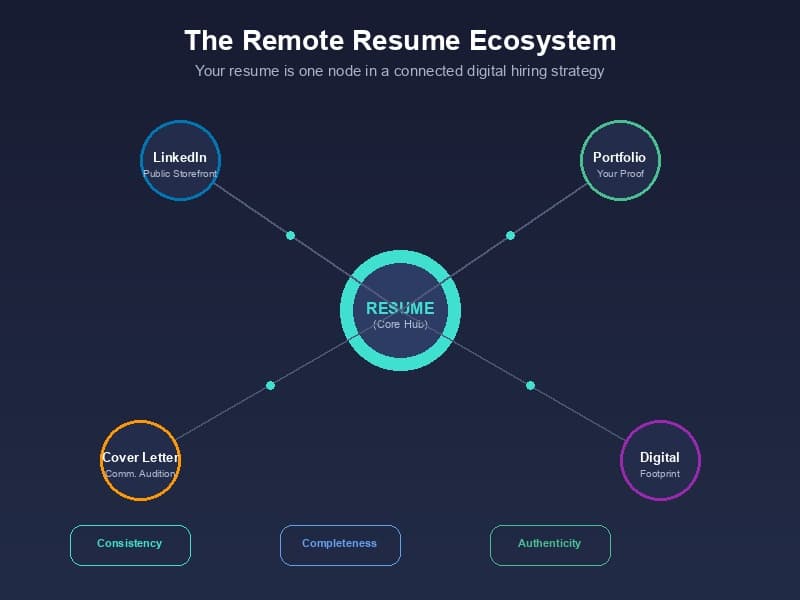
Here's the framework I use when coaching candidates for remote positions. I call it the Remote Resume Ecosystem, and it has five interconnected components:
1. The Resume (Your Core Document) This is your structured pitch -- optimized for ATS, tailored for the specific remote role, and packed with evidence of autonomous work. It's the hub that everything else connects to.
2. Your LinkedIn Profile (Your Public Storefront) Remote recruiters live on LinkedIn. Your profile needs to mirror your resume's narrative while adding depth: recommendations from remote colleagues, posts about remote work practices, and a headline that screams "I thrive remotely."
3. Your Portfolio or Work Samples (Your Proof) For remote roles, showing beats telling. A portfolio doesn't have to be a designer's website -- it can be case studies, writing samples, documented project outcomes, or even a well-maintained GitHub profile.
4. Your Cover Letter (Your Communication Audition) In remote hiring, the cover letter carries more weight than in traditional settings. It's your first demonstration of written communication skills -- the single most important competency for remote work.
5. Your Digital Footprint (Your Background Check) Blog posts, community contributions, open-source work, forum answers. Remote employers Google candidates more thoroughly because they can't rely on in-person impressions.
The key insight is that these five elements need to tell a consistent story. If your resume says you're an expert in asynchronous collaboration but your LinkedIn shows no evidence of remote work, that's a red flag.
Structuring Your Remote Resume for Maximum Impact
Let me walk through the sections of a remote-optimized resume, from top to bottom.
The Header: Location Strategy Matters
For remote roles, your header needs to communicate availability, not just location. Include:
- Your city and time zone (e.g., "Austin, TX | CST/UTC-6")
- "Open to Remote" or "Remote-First Professional" as a tagline
- LinkedIn URL (customized, not the default random string)
- Portfolio link if applicable
Why the time zone? Remote employers need to know if you'll overlap with their team. A candidate in UTC+8 applying to a company with core hours in EST needs to address this upfront. Being transparent saves everyone time.
The Professional Summary: Lead with Remote Identity
Your summary should accomplish three things in 3-4 lines:
- Establish your professional expertise
- Quantify your remote work experience
- Signal your communication and collaboration style
Weak example: "Experienced marketing manager seeking remote opportunities."
Strong example: "Marketing manager with 6+ years of experience, including 4 years leading fully distributed teams across 3 time zones. Built and scaled a content operation from 10K to 250K monthly organic visitors using async-first workflows in Notion and Slack. Known for over-communicating progress and writing documentation that eliminates unnecessary meetings."
See the difference? The strong version answers those critical remote hiring questions before the employer even has to ask.
The Skills Section: Speak the Remote Language
This is where most candidates completely miss the mark. They list technical skills but ignore the operational and communication skills that remote employers prioritize.
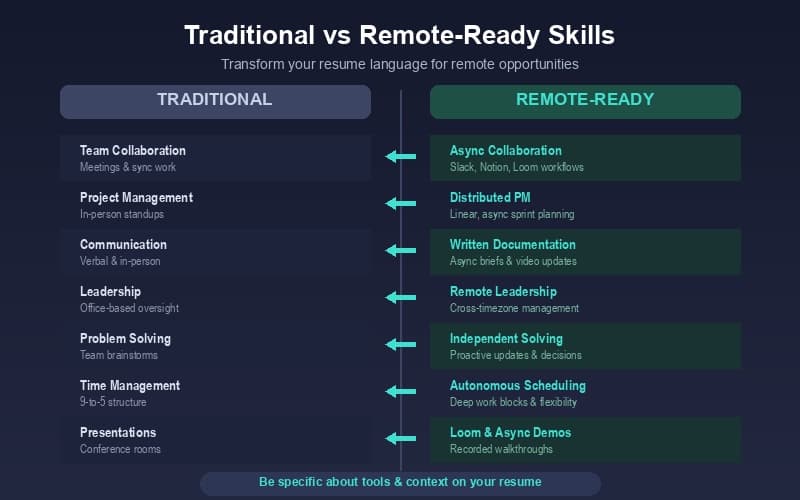
Here's a skills mapping framework I recommend -- translating traditional skills into their remote equivalents:
| Traditional Skill | Remote-Ready Equivalent |
|---|---|
| Team collaboration | Asynchronous collaboration (Slack, Notion, Loom) |
| Project management | Distributed project management (Jira, Linear, Asana) |
| Communication | Written communication & async documentation |
| Leadership | Remote team leadership across time zones |
| Problem-solving | Independent problem-solving with proactive updates |
| Meetings & presentations | Loom recordings, async stand-ups, written briefs |
| Onboarding new hires | Remote onboarding & virtual culture building |
| Data analysis | Self-serve analytics & dashboard creation |
| Time management | Autonomous schedule management & deep work blocks |
| Networking | Digital community building & virtual relationship management |
When listing these skills on your resume, be specific about the tools. Don't just say "project management" -- say "Distributed project management using Linear with async sprint planning." The specificity proves you've actually done it, not just read about it. For a deeper dive into how to showcase analytical skills with concrete examples, we've put together a detailed guide.
The "AI-Native Remote Worker" Skills Block
Here's where you can genuinely stand out in 2025 and beyond. Remote work and AI adoption are converging, and employers want candidates who can leverage both.
Consider adding a dedicated section called "AI & Remote Productivity Stack" that includes:
- AI-assisted writing and editing (ChatGPT, Claude, Grammarly for async communication)
- AI-powered project workflows (automated standup summaries, AI ticket triaging)
- Prompt engineering for team productivity (creating reusable prompts for documentation, reporting)
- AI-enhanced data analysis (using AI tools for quick insights without waiting for a data team)
This signals that you're not just comfortable working remotely -- you're at the cutting edge of how remote work is evolving. It tells employers you'll bring efficiency gains to their team, not just fill a seat.
Tailoring Your Experience Section for Remote Credibility
Your work experience section needs a remote-specific rewrite. Here's the framework I use:
Distinguish Your Remote Work Model
Not all remote work is the same, and employers know it. Be explicit about which model you worked in:
- Fully Remote: No office, entirely distributed team, all communication digital
- Hybrid Remote: Split between office and remote, with structured in-person days
- Async-First: Team operates primarily through written communication across time zones, with minimal synchronous meetings
- Remote-Friendly: Primarily office-based company that allows remote work
A candidate who thrived in an async-first environment for three years is fundamentally different from someone who worked from home twice a week at an office-centric company. Make the distinction clear.
Quantify Remote-Specific Achievements
Every bullet point in your experience section should follow this formula:
[Action verb] + [what you did] + [in what remote context] + [measurable result]
Here are some examples:
- "Managed a 12-person engineering team distributed across 5 countries, delivering product updates on a 2-week sprint cycle with 94% on-time completion rate"
- "Designed and implemented an async onboarding program that reduced new hire ramp-up time from 8 weeks to 4 weeks, documented entirely in Notion"
- "Led cross-functional product launches across 3 time zones using Loom video updates and written briefs, eliminating 6 hours of weekly synchronous meetings"
Notice how each bullet demonstrates not just what you achieved, but how you achieved it in a remote context. That's the difference between a generic resume and a remote-optimized one.
The Cross-Border Remote Resume: International Considerations
If you're applying to remote roles across borders -- and you should be, since that's one of the biggest advantages of remote work -- there are additional considerations:
Legal work authorization: Clearly state your work authorization status and whether you're open to contractor arrangements. Many international remote roles use Employer of Record (EOR) services like Deel or Remote.com.
Currency and compensation: If you have experience working with international pay structures, mention it. It shows you understand the complexities of cross-border employment.
Cultural competency: Working across cultures remotely is harder than doing it in person. If you've successfully collaborated with teams in different cultural contexts, highlight it prominently.
Language proficiency: List languages with proficiency levels. Even basic proficiency in a second language signals cultural awareness and adaptability.
According to Buffer's State of Remote Work report, the number of workers collaborating across borders has grown significantly, making cross-cultural remote competency increasingly valuable.
Career Changers: Breaking into Remote Work
If you're transitioning from an in-office career to remote work, your resume needs to bridge the credibility gap. Here's how:
Reframe existing experience: Even if you've never held a "remote" title, you've likely done remote-adjacent work. Did you coordinate with other offices? Manage vendors via email? Lead virtual client meetings? These all count.
Invest in remote credentials: Take courses on remote work practices. Certifications from platforms like We Work Remotely or Coursera's remote collaboration courses add legitimacy.
Start with freelance or contract remote work: Even a few months of freelance remote work gives you concrete experience to put on your resume. It's the fastest way to close the gap.
Lead with transferable skills: Strong writing, self-motivation, and project management translate directly to remote work. Our software engineer resume guide covers how to present technical skills effectively -- the same principles apply when pivoting to remote roles.
LinkedIn + Resume Alignment: The Consistency Check
Here's a mistake I see constantly: a polished resume paired with a neglected LinkedIn profile. In remote hiring, this is deadly.
Remote recruiters will check your LinkedIn before they ever open your resume. If the two documents tell different stories -- different job dates, different skill emphasis, different professional narrative -- you've planted a seed of doubt.
Here's my alignment checklist:
- Headlines match: Your resume's professional summary and your LinkedIn headline should convey the same positioning
- Job titles and dates are identical: Even small discrepancies trigger red flags
- Skills are consistent: If your resume highlights async collaboration, your LinkedIn skills section should too
- Recommendations support your narrative: Request LinkedIn recommendations specifically mentioning your remote work capabilities
- Activity signals expertise: Share content about remote work, comment on industry posts, and engage with remote work communities
ATS Optimization for Remote Job Applications
Remote jobs attract massive applicant pools, which means companies rely heavily on ATS filtering. Here's how to get through:
Use exact keyword matches. If the job posting says "asynchronous communication," use that exact phrase -- not "async comms" or "written updates." ATS systems are literal.
Include a dedicated "Remote Tools" section. List every collaboration tool you've used: Slack, Zoom, Notion, Asana, Linear, Loom, Miro, Figma, GitHub, GitLab. ATS systems scan for these.
Mirror the job posting's language. If they say "distributed team," you say "distributed team." If they say "work from anywhere," use that phrase. This isn't gaming the system -- it's speaking the employer's language.
Format simply. Avoid tables, graphics, headers/footers, and fancy formatting that ATS systems can't parse. Use a clean, single-column layout. If you need a reliable starting point, browse our resume templates designed to be both ATS-friendly and visually professional.
Your Remote Resume Action Plan
Let me give you a concrete, step-by-step plan to implement everything in this guide:
Week 1: Audit and Foundation
- Review your current resume against the remote skills mapping table above
- Identify gaps in your remote-specific language and accomplishments
- Update your LinkedIn profile to align with your remote positioning
Week 2: Rewrite and Optimize
- Rewrite your professional summary with a remote-first identity
- Add your AI & Remote Productivity Stack section
- Reformat every experience bullet using the remote achievement formula
- Run your resume through an ATS checker
Week 3: Build the Ecosystem
- Create or update your portfolio with remote-relevant work samples
- Request LinkedIn recommendations that speak to your remote capabilities
- Draft a cover letter template that demonstrates your written communication skills
Week 4: Test and Iterate
- Apply to 5-10 remote roles and track response rates
- A/B test different versions of your professional summary
- Adjust based on which applications get callbacks
Final Thoughts: The Remote Resume Is a Living Document
The biggest mistake remote job seekers make is treating their resume as a static document. In the remote hiring ecosystem, your resume should evolve with every application. Each job posting teaches you new keywords. Each interview reveals what employers are actually looking for. Each rejection is data.
Remote work isn't just a perk anymore -- it's a distinct professional discipline with its own skills, tools, and communication norms. Your resume needs to reflect that you understand this distinction, not just that you own a laptop and a decent internet connection.
The candidates who land the best remote roles aren't necessarily the most technically skilled. They're the ones who've built a cohesive digital presence that says, "I don't just want to work remotely. I know how to work remotely, and here's the proof."
Start building your ecosystem today. Your resume is just the beginning.