
Networking Strategies for Job Search: The 30-Day Sprint That Gets You Hired in 2026


I used to think networking meant awkward cocktail parties where you shove business cards at strangers while pretending to enjoy lukewarm appetizers. That belief cost me roughly eight months of unemployment after a layoff in 2023.
When I finally swallowed my pride and sent a two-sentence LinkedIn message to a former coworker, everything changed. Within three weeks I had two interviews lined up -- neither from a job board, neither from a cold application. One of those conversations turned into my current role.
That experience reshaped how I think about networking strategies for job search. And the data backs it up: according to Apollo Technical, 85% of all jobs are filled through networking, and roughly 70% of positions are never publicly advertised. If you're only applying through job boards, you're fighting over a fraction of what's actually available.
The problem isn't that people don't know networking matters -- Forbes reports that 84% of professionals acknowledge its importance. The problem is that 59% don't know where to begin. They open LinkedIn, stare at the screen, and close the tab.
This article fixes that. I'm going to walk you through a concrete 30-day networking sprint -- week by week, with the exact message templates I used, a tracking approach that keeps you accountable, and specific tactics for introverts who'd rather do anything than "put themselves out there."
Why Networking Beats Cold Applications (The Numbers Don't Lie)
Before we get into the plan, let's look at why this matters so much -- especially if you're dealing with the frustrating reality of today's job market.
| Method | Success Rate | Time Investment | Best For |
|---|---|---|---|
| Employee Referral | 30-50% | Medium | Roles at known companies |
| Direct Outreach | 33-80% | Medium-High | Hidden market, startups |
| Recruiter Networking | 15-30% | Low-Medium | Senior/specialized roles |
| Job Boards | 2-5% | High | Volume strategy |
| Cold Application | 4-10% | High | Large companies with ATS |
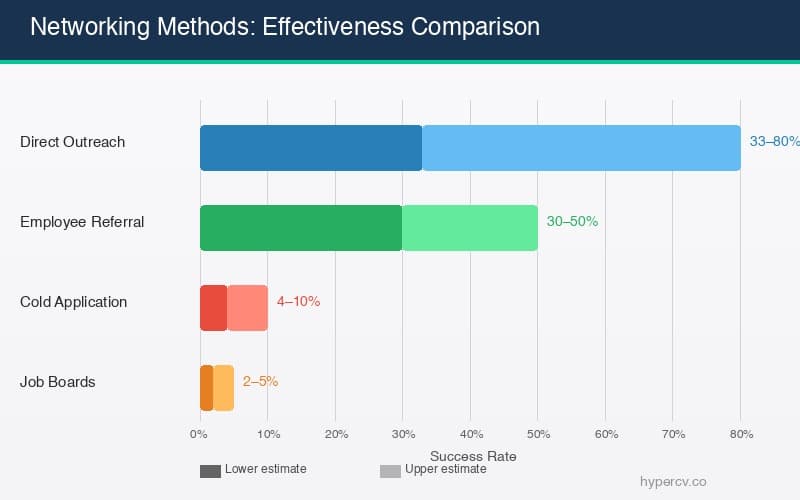
The takeaway is stark. Referrals account for 30-50% of all hires while representing only about 7% of applicants, according to LinkedIn's hiring data. Meanwhile, cold applications through portals have a success rate hovering between 4 and 10 percent. Direct outreach -- where you contact someone at a company before or alongside your application -- pushes success rates as high as 33 to 80 percent depending on the industry and how warm the connection is.
You don't need to be an extrovert. You don't need a massive existing network. You just need a plan.
The 30-Day Networking Sprint
I developed this framework after my own experience and refined it by talking to career coaches, recruiters, and hiring managers. The goal isn't to become a networking machine forever -- it's to build a focused 30-day habit that produces real results.
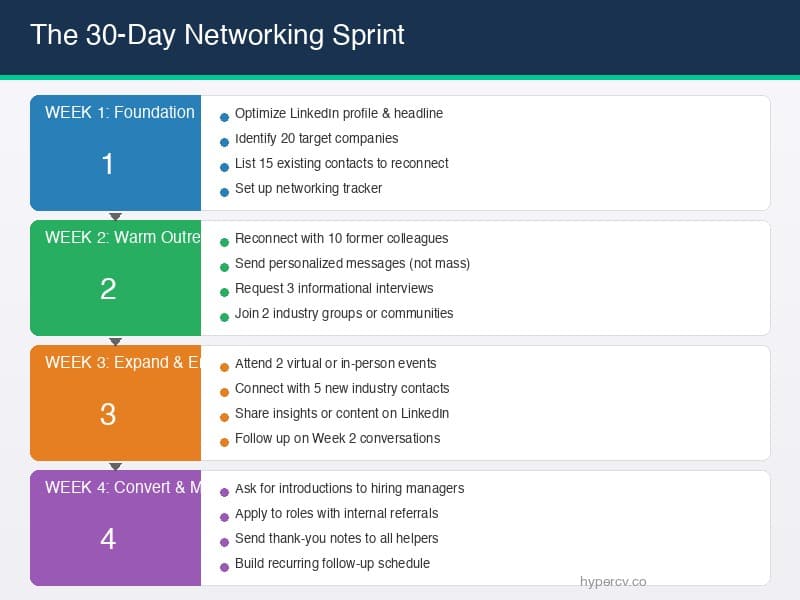
Week 1: Build Your Foundation (Days 1-7)
The first week is about preparation. You're not reaching out to anyone yet -- you're making sure that when you do, everything is ready.
Day 1-2: Audit your LinkedIn profile. Your profile is your networking resume. Make sure your headline includes your target role (not just your current title), your summary tells a clear story, and your experience section highlights results. If you need a polished resume to match, browse proven templates that translate well to LinkedIn.
Day 3-4: Build your target list. Identify 20 companies you'd genuinely want to work for. For each one, find 2-3 people on LinkedIn who work in your target department or in a role one level above what you're aiming for. That gives you 40-60 potential contacts.
Day 5-6: Map your existing network. Open your phone contacts, your LinkedIn connections, your old email. List every person you've worked with, gone to school with, or interacted with professionally in the last five years. You'll be surprised -- most people have 50-100 viable contacts they've forgotten about.
Day 7: Set up your tracker. Create a simple spreadsheet with these columns: Name, Company, Relationship (warm/cold), Date Contacted, Response, Follow-up Date, Notes, Status. This sounds basic, but having a system transforms networking from "I should reach out to people" into a measurable process. Track everything. I'll explain why in Week 4.
Week 2: Warm Outreach (Days 8-14)
Now you start reaching out -- beginning with people you already know.
Goal: Send 10 personalized reconnection messages and request 3 informational interviews.
This is where most people freeze, so here are the exact templates I used:
Template 1: Reconnecting with a Former Colleague
Hi [Name], I was just thinking about our time at [Company] and that [specific project or memory]. I hope you're doing well at [their current company]!
I'm currently exploring new opportunities in [field/role type] and would love to hear about your experience at [company]. Would you have 15 minutes for a quick catch-up call this week or next?
Why this works: it's personal, it's specific, and it asks for a small commitment (15 minutes, not "let's get coffee sometime").
Template 2: Requesting an Informational Interview
Hi [Name], I came across your profile while researching [industry/company] and was impressed by your path from [previous role] to [current role].
I'm transitioning into [field] and would love to learn about your experience. Would you be open to a brief 15-minute conversation? I have a few specific questions about [topic] that I think your perspective would really help with.
Template 3: Reaching Out Through a Mutual Connection
Hi [Name], [Mutual connection] suggested I reach out to you. I'm exploring opportunities in [field] and they mentioned you'd be a great person to talk to about [specific aspect].
Would you be open to a brief chat? I'd really appreciate your perspective.
During this week, also join 2 industry-specific communities -- whether that's a Slack group, a Discord server, a subreddit, or a local professional association chapter. Don't pitch yourself immediately. Just introduce yourself and start participating in conversations.
Week 3: Expand and Engage (Days 15-21)
By now you should have had a few conversations and received some responses. Week 3 is about expanding beyond your warm network.
Goal: Attend 2 events (virtual counts), connect with 5 new people, and share one piece of content.
Attend events strategically. You don't need to go to generic "networking mixers." Look for industry panels, webinars, meetups, or conferences where the attendees are likely to work at your target companies. Virtual events are completely valid -- many have chat features or breakout rooms where meaningful connections happen.
Follow up on every Week 2 conversation. If someone gave you advice, tell them you followed it. If they mentioned a contact, ask for the introduction. If they said they'd keep you in mind, send a brief update about what you've been working on.
Post one piece of thoughtful content on LinkedIn. This could be a lesson learned, an industry take, or a summary of something interesting you read. You don't need to go viral -- you just need to show up in your network's feeds as someone who's engaged and knowledgeable.
Template 4: Following Up After an Informational Interview
Hi [Name], thank you again for taking the time to chat last [day]. Your advice about [specific point] was really helpful -- I've already started [specific action you took].
I noticed [Company] just posted a [Role] position. Based on our conversation, I think it could be a great fit. Would you be comfortable introducing me to the hiring manager, or would you recommend I apply directly and mention your name?
This template does two critical things: it shows you actually listened and took action, and it makes a specific ask.
Week 4: Convert and Maintain (Days 22-30)
The final week is about turning conversations into opportunities and building a sustainable system.
Goal: Secure at least 2 referral-backed applications and establish a recurring follow-up cadence.
Ask for introductions -- directly. By now, you've built enough rapport with several contacts to make specific asks. The people who had coffee chats with you, the ones who offered to help -- take them up on it.
Template 5: Asking for a Referral
Hi [Name], I really appreciated our conversations over the past few weeks. Your insights about [topic] have been incredibly valuable as I navigate this transition.
I noticed that [Company] has a [specific role] opening that aligns well with my background in [relevant experience]. Would you feel comfortable referring me or connecting me with the hiring team? I'd be happy to send you my updated resume and a brief summary of why I think I'd be a strong fit.
Apply with insider context. When you apply to roles where you've networked, you can tailor your application using what you've learned from conversations. You'll know the team's pain points, the company culture, and what they actually value -- information that never shows up in a job posting.
Send thank-you notes. Everyone who helped you -- even people who just responded to say they couldn't chat right now -- deserves a thank you. This isn't just politeness; it's how you maintain relationships for the long term.
Set up monthly check-ins. The biggest networking mistake is treating it as a one-time job search activity. Add quarterly reminders to reach out to your top 10-15 contacts. Share an article, congratulate them on a work anniversary, or just say hello.
Networking for Introverts: You Don't Have to Become Someone Else
I'm going to be direct: I'm an introvert. Large networking events drain me. Small talk feels performative. And the advice to "just put yourself out there" has always felt like telling someone with a fear of heights to "just climb the ladder."
Here's what actually works for introverts:
Lean into written communication. Email and LinkedIn messages let you craft thoughtful, specific outreach at your own pace. You don't have to be spontaneous or charming on the spot. Some of my most productive networking relationships started with a well-written paragraph.
Prefer one-on-one over group settings. Skip the mixer. Instead, request individual coffee chats or 15-minute Zoom calls. Introverts tend to build deeper connections in focused conversations, and those deeper connections are more valuable for job searching anyway.
Prepare questions in advance. Before any conversation, write down 3-5 specific questions. This removes the pressure of thinking on your feet and ensures the conversation stays substantive. Good questions include:
- What's the biggest challenge your team is facing right now?
- What do you wish you'd known before joining [company]?
- How does the hiring process actually work for your department?
Use the "energy budget" approach. Plan no more than 2-3 networking interactions per week. Quality matters far more than quantity. Three meaningful conversations will produce better results than fifteen superficial ones.
Leverage async networking. Comment thoughtfully on LinkedIn posts. Engage in industry Slack channels at your own pace. Write articles or share insights. These all build visibility without requiring real-time social performance.
Your Networking Tracker: Measure What Matters
The tracker I mentioned in Week 1 isn't just organizational -- it's motivational. Here's what to measure:
- Outreach rate: How many messages sent per week (aim for 8-12)
- Response rate: What percentage replied (healthy: 25-40%)
- Conversation rate: How many outreaches turned into actual conversations
- Referral rate: How many conversations generated referrals or introductions
- Application quality: How many applications included an internal connection
After 30 days, you should see a clear picture of what's working. In my case, I found that warm reconnections had a 45% response rate, while cold outreach to strangers hovered around 15% -- but the cold outreach that did convert led to some of my best opportunities because those contacts were at companies I'd specifically targeted.
Common Mistakes That Kill Your Networking Efforts
Leading with "I need a job." This puts all the pressure on the other person. Instead, lead with curiosity and genuine interest. Ask about their work, their company, their perspective. The job conversation will happen naturally.
Sending generic messages. "I'd love to connect and pick your brain" is the networking equivalent of a form letter. Reference something specific -- a post they wrote, a project they worked on, a mutual experience.
Not following up. A single outreach message without follow-up has a ~20% response rate. A polite follow-up a week later can push that to 35-40%. People are busy; they're not ignoring you.
Networking only when you need something. The best time to build your network is before you need it. If you're currently employed, start investing in relationships now. When the time comes, you'll have warm contacts instead of cold ones.
Neglecting your materials. Before you start networking, make sure your resume and LinkedIn profile are polished and consistent. Having a strong resume ready to share ensures you're prepared when someone says, "Send me your resume and I'll pass it along."
What Happens After Day 30
If you follow this sprint consistently, here's what you should realistically expect:
- 40-60 outreach messages sent across warm and cold contacts
- 12-20 meaningful conversations (informational interviews, catch-ups, event connections)
- 3-5 referral-backed applications to specific roles
- 2-3 ongoing mentoring relationships that extend beyond your current search
Those referral-backed applications alone shift your odds dramatically. Remember: a referred candidate has a 30-50% chance of getting hired, compared to 4-10% for a cold applicant.
And here's the part nobody talks about: even if you don't land a role directly from your 30-day sprint, you'll have built a network that compounds. Three months later, someone you chatted with will think of you when a role opens up. Six months later, a contact will forward your name to a recruiter. This is how careers actually work.
Putting It All Together
Networking isn't about being the most connected person in the room. It's about being intentional, consistent, and genuinely interested in other people's work.
Start with what you have. Your existing contacts -- former colleagues, college friends, that person you met at a conference two years ago -- are more willing to help than you think. But they can't help if they don't know you're looking.
Make sure your application materials are ready before you start your sprint. Prepare for the conversations that networking creates by reviewing common interview questions. And when those conversations lead to real interviews, have a solid follow-up strategy to keep the momentum going.
The 30-day sprint works because it turns a vague, overwhelming activity into a structured process with clear actions, real deadlines, and measurable results. You don't need to love networking. You just need to do it -- systematically, for 30 days.
Open your LinkedIn right now. Pick one person from your past who you genuinely respected working with. Send them a message. That's Day 1.