
How to Write a Cover Letter That Beats ATS and Impresses Hiring Managers (2025 Guide)

I used to think cover letters were dead. Then I spent three months applying to jobs without one and got exactly two callbacks out of 87 applications. When I finally started writing tailored cover letters again, my callback rate jumped to nearly 1 in 4. That experience taught me something most job advice articles miss: your cover letter has to impress two very different readers — the ATS software that scans it first and the human hiring manager who reads it second.
In this guide, I am going to show you exactly how to write a cover letter that satisfies both. No fluff, no generic templates — just a practical, psychology-backed framework with before-and-after examples you can use today.
Why Cover Letters Still Matter in 2026
Let me address the elephant in the room. You have probably heard that nobody reads cover letters anymore. The data tells a different story.
According to a 2024 ResumeGo study, 83% of hiring managers read cover letters when making hiring decisions. Even more striking, 45% of recruiters read the cover letter before even glancing at the resume. Your cover letter is not a formality — it is often your first impression.
But here is where it gets complicated. Before a human ever sees your application, an Applicant Tracking System (ATS) parses and scores it. If your cover letter does not pass the ATS filter, no human will ever read your carefully crafted prose.
That is why you need to optimize for both readers simultaneously. Think of it as writing for a robot audience and a human audience at the same time — and satisfying both.
When You Should (and Should Not) Write a Cover Letter
Before we dive into the how, let me save you some time. Not every application needs a cover letter.
Always Write a Cover Letter When:
- The job posting explicitly requests one — skipping it signals you do not follow directions
- You are changing careers and need to explain the transition
- You have employment gaps that need context
- You are applying to a small or mid-size company where applications get personal attention
- The role is in communications, writing, marketing, or PR — your cover letter IS a work sample
You Can Skip the Cover Letter When:
- The application system has no field for uploading one
- The posting explicitly says "no cover letter needed"
- You are applying through a quick-apply button on LinkedIn with no attachment option
- You are submitting to a high-volume recruiter who has stated they will not read them
For most serious job applications, a strong resume paired with a targeted cover letter gives you the strongest chance.
Understanding Your Two Readers: ATS vs. Human
This is the core concept that makes this guide different. Every piece of advice I give you needs to work for both readers. Here is what each one is looking for:
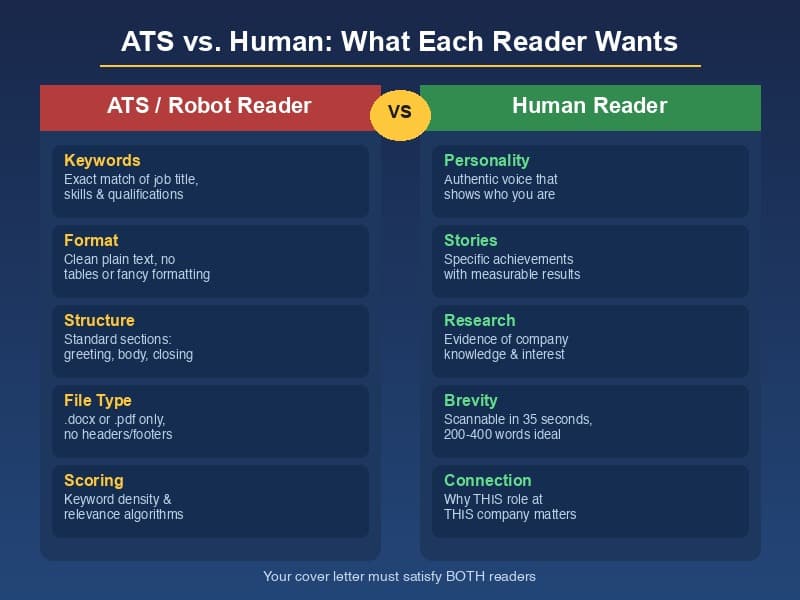
| Criteria | What ATS Wants | What the Human Wants |
|---|---|---|
| Keywords | Exact match of job title, skills, and qualifications from the posting | Natural language that shows genuine understanding of the role |
| Format | Clean plain text, standard headings, no tables or columns | Professional layout that is easy to scan in 35 seconds |
| Content | Quantifiable achievements, industry terminology | Personality, specific stories, evidence of company research |
| Structure | Predictable sections (greeting, body, closing) | Logical flow that builds a compelling case |
| Length | Parseable text blocks, not too short to score | 200-400 words (studies show a 53% higher callback rate at this length) |
| Tone | Professional terminology matching the job description | Authentic voice that conveys enthusiasm without desperation |
The good news? These are not mutually exclusive. With the right approach, you can satisfy both readers in a single document.
The 5-Part Cover Letter Structure That Works for Both Readers
Here is the framework I use and recommend. Each section serves a dual purpose.
Part 1: The Header (ATS Setup + Professional Appearance)
For ATS: Include your full name, email, phone number, and the exact job title you are applying for. The ATS uses this to match your application to the right position.
For humans: A clean, professional header signals attention to detail.
Sarah Chen
sarah.chen@email.com | (555) 234-5678 | San Francisco, CA
LinkedIn: linkedin.com/in/sarahchen

March 22, 2025

Hiring Manager
Acme Corp
Re: Senior Marketing Manager (Job ID: MKT-2025-089)
Pro tip: Always include the job ID or exact title from the posting. This is one of the first things ATS software matches on.
Part 2: The Opening Hook (Keyword Placement + Human Connection)
Your first paragraph needs to accomplish two things simultaneously: drop critical keywords naturally and grab the hiring manager's attention within their average 35-second reading window.
The formula: Lead with a specific, relevant achievement → Connect it to the company's needs → Include 2-3 primary keywords from the job description.
Before and After: Opening Paragraph
BEFORE (Generic — fails both readers):
"I am writing to express my interest in the Marketing Manager position at your company. I am a hardworking professional with experience in marketing and I believe I would be a great fit for your team. I am excited about this opportunity and look forward to contributing to your organization's success."
What is wrong: No keywords beyond the basic job title (ATS gives low relevance score). No specifics, no personality, no evidence (human stops reading). Uses cliches like "hardworking professional" and "great fit" that convey nothing.
AFTER (Optimized for both readers):
"When I led a product launch campaign at Rivera Tech that generated 2.4M impressions and a 34% increase in qualified leads within 60 days, I used the exact multichannel content strategy and marketing automation skills your Senior Marketing Manager posting describes. I have followed Acme Corp's pivot into the B2B SaaS space, and I believe my seven years scaling demand generation programs can help accelerate the pipeline growth your VP of Marketing discussed in her recent MarketingProfs interview."
Why this works: Contains specific keywords from the job posting — "multichannel content strategy," "marketing automation," "demand generation" (ATS scores it highly). Shows measurable results, company research, and genuine interest (human is intrigued). The achievement is concrete and relevant, not vague.
Part 3: The Evidence Body (Skills Matching + Storytelling)
This is the meat of your cover letter. You need 2-3 short paragraphs, each following this pattern:
- State the employer's need (pulled from the job description keywords)
- Tell a brief, specific story that proves you can meet that need
- Quantify the result wherever possible
For ATS: You are naturally incorporating keywords and required qualifications.
For humans: You are using the proven persuasion technique of showing rather than telling. Anyone can claim they are "results-oriented." You are proving it.
Example paragraph:
"Your posting emphasizes the need for someone who can manage cross-functional teams and optimize conversion funnels. At Rivera Tech, I restructured the marketing-sales handoff process, collaborating with a 12-person cross-functional team across product, sales, and customer success. We implemented a lead scoring model that improved MQL-to-SQL conversion by 28% and shortened the average sales cycle from 47 to 31 days."
Notice how every keyword — "cross-functional teams," "conversion funnels," "lead scoring" — appears because they are part of a real story, not because they were awkwardly shoehorned in.
Part 4: The Company Connection (Research Proof + Cultural Fit)
This is where most cover letters fall flat, and where yours can stand out dramatically. Dedicate one paragraph to showing that you understand this specific company.
For ATS: This section often includes company-specific terminology and industry keywords that boost relevance scoring.
For humans: This is the paragraph that separates the mass applicants from the genuinely interested candidates. It also demonstrates that you understand the differences between a cover letter and a resume — the resume lists your qualifications, while the cover letter tells the story of why this particular role matters to you.
"I am particularly drawn to Acme Corp's commitment to product-led growth — your recent launch of the self-serve analytics tier shows a willingness to disrupt the traditional enterprise sales model that I find exciting. Having helped Rivera Tech transition from a sales-led to a hybrid PLG motion, I understand both the marketing challenges and the enormous opportunities this shift creates."
Part 5: The Confident Close (Call to Action + Professional Sign-Off)
End with confidence, not desperation. Avoid "I hope to hear from you" — it sounds passive. Instead:
"I would welcome the chance to discuss how my demand generation and cross-functional leadership experience can support Acme Corp's growth targets. I am available for a conversation at your convenience and can be reached at (555) 234-5678 or sarah.chen@email.com."
"Thank you for your time and consideration."
"Best regards, Sarah Chen"
For ATS: Restating key skills gives one more keyword hit.
For humans: The confident, specific close creates a professional final impression and makes it easy to take the next step.
Key Statistics That Should Shape Your Cover Letter Strategy
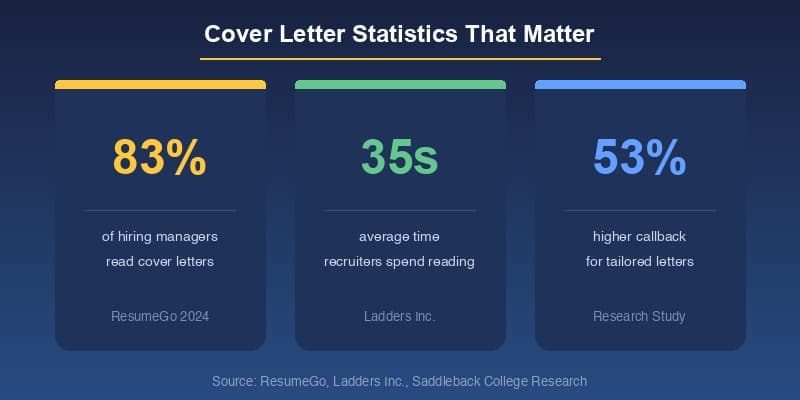
Understanding the data behind hiring decisions helps you make smarter choices about where to invest your time:
| Statistic | Source | What It Means for You |
|---|---|---|
| 83% of hiring managers read cover letters | ResumeGo 2024 | Your cover letter WILL be read — invest the time |
| 45% read the cover letter first | ResumeGo 2024 | The cover letter may shape how they interpret your resume |
| 200-400 words = 53% higher callback | Saddleback College Research | Keep it concise — every sentence must earn its place |
| Recruiters spend avg 35 seconds reading | Ladders Inc. Eye-Tracking Study | Front-load your strongest points in the first paragraph |
| 75% of large companies use ATS | Forbes / Jobscan | ATS optimization is not optional for enterprise applications |
| Tailored letters get 50% more interviews | Forbes | Generic templates actively hurt your chances |
ATS Optimization Checklist
Before you submit, run through this checklist to make sure your cover letter survives ATS parsing:
- Use a standard file format — .docx or .pdf (check the application instructions for preference)
- Avoid headers and footers — some ATS cannot read content placed there
- Do not use tables, text boxes, or columns — they break parsing
- Mirror the exact job title from the posting (do not abbreviate or get creative)
- Include 5-8 keywords from the job description, used naturally in context
- Use standard section labels if any — "Re:" for the subject line, not clever alternatives
- Skip images and graphics — ATS cannot read them and they may cause parsing errors
- Use standard fonts — Arial, Calibri, Times New Roman, or Georgia
Common Mistakes That Kill Cover Letters
After reviewing hundreds of cover letters as a hiring manager myself, here are the mistakes I see most often:
1. The Resume Rehash
Your cover letter is not a prose version of your resume. Your resume provides the facts. Your cover letter provides the narrative — the why behind the what.
2. The "Dear Sir/Madam" Opening
If you cannot find the hiring manager's name on LinkedIn, the company website, or by calling the front desk, use "Dear Hiring Manager" or "Dear [Department] Team." Never use "To Whom It May Concern" — it signals zero research effort.
3. The Wall of Text
Break your letter into 3-4 short paragraphs. Hiring managers are scanning in 35 seconds, not reading a novel.
4. The Desperation Close
"I really need this job" and "I would be so grateful for any opportunity" undermine your professional positioning. You are not begging — you are proposing a mutually beneficial partnership.
5. The One-Size-Fits-All Template
According to Forbes, tailored cover letters receive 50% more interview invitations than generic ones. If you are using the same letter for every application, you are actively hurting your chances.
Putting It All Together: Your Action Plan
Here is your step-by-step process for every application:
- Read the job posting twice. The first time for understanding, the second time to highlight keywords, required skills, and qualifications.
- Research the company. Spend 10 minutes on their website, recent news, and the hiring manager's LinkedIn profile.
- Choose 2-3 achievements from your experience that directly map to the job's top requirements.
- Write your draft using the 5-part structure above, naturally weaving in 5-8 keywords from the posting.
- Run the ATS checklist to ensure technical compatibility.
- Read it aloud. If it sounds robotic or generic, add more specific details. If it sounds too casual, tighten the language.
- Check the word count. Aim for 250-350 words in the body (excluding header and sign-off).
Need help formatting your application materials? Check out our professionally designed templates to make sure your cover letter and resume present a polished, cohesive package.
Final Thought
The best cover letter I ever wrote took me 45 minutes. It landed me an interview within 24 hours, and I got the job. The worst cover letters I have written took me 5 minutes each — mass-produced, generic, forgettable. The math is clear: investing real time in a targeted cover letter that speaks to both the ATS and the human behind the desk is one of the highest-ROI activities in your job search.
You are not just writing a letter. You are building a bridge between what you have done and what they need done. Make every word count for both readers.