
Career Change Resume: The 90-Day Strategy That Actually Works in 2026


I spent six years as a restaurant manager before switching into tech recruiting. When I sat down to rewrite my resume, I stared at a blank screen for two hours. Everything I had done felt irrelevant. Every bullet point screamed "hospitality" when I wanted it to whisper "talent acquisition."
If that paralysis sounds familiar, you are not alone. According to a 2023 survey reported by Apollo Technical, 49% of American workers have made a dramatic career shift at some point, and the average age of a career changer is 39. The workforce is not static, and your resume should not pretend it is.
Here is the problem most guides miss: they tell you to "emphasize transferable skills" and call it a day. That advice is not wrong, but it skips the hardest part — what do you do when you genuinely lack experience in your target field? You cannot fake it through an ATS that rejects 75% of resumes before a human ever sees them.
That is why I developed what I call The 90-Day Career Change Resume Build — a phased strategy that does not just reformat your old career onto paper. It helps you create the evidence you need, then present it in a way that makes hiring managers lean forward instead of reaching for the rejection pile.
Why Traditional Resume Advice Falls Short for Career Changers
Most resume guides assume you are moving laterally — same industry, slightly different role. They tell you to tweak a few bullet points, update your resume summary, and hit "apply." But a career change is a vertical leap. You are asking an employer to take a bet on someone whose entire professional history points in a different direction.
The good news? The hiring landscape is shifting in your favor. According to research from the Wharton School, 85% of employers have adopted or plan to adopt skills-based hiring practices, reducing their reliance on traditional credentials. This means your abilities matter more than your job titles — but only if your resume communicates those abilities clearly.
Traditional advice also ignores the psychological dimension. Career changers battle something lateral movers rarely face: imposter syndrome on paper. You look at your resume and think, "Who am I kidding? I'm a teacher applying to be a UX researcher." That mental block leads to one of two mistakes — either you overexplain your old career (burying the reader in irrelevant detail) or you strip your resume so thin it looks like you have no experience at all.
The 90-day framework solves both problems. It gives you real, new experience to write about and a structured way to present your full career arc as a coherent story.
The 90-Day Career Change Resume Build
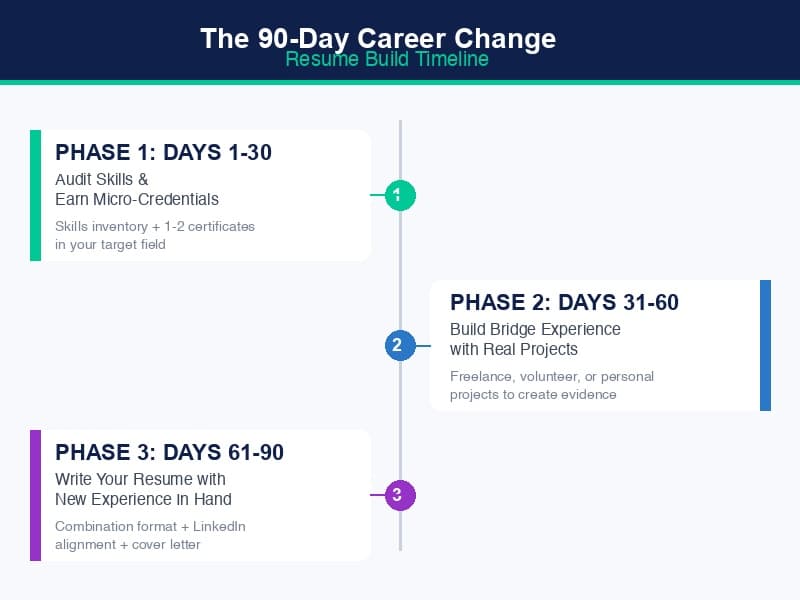
Phase 1: Days 1-30 — Audit Your Skills and Stack Micro-Credentials
Before you write a single word on your resume, you need an honest inventory. Grab a notebook (or a spreadsheet, if you are that kind of person) and list every skill you have used in your current and past roles. Do not filter. Do not judge. Just list.
Now, sort them into three columns:
- Directly transferable: Skills that translate with zero explanation (project management, data analysis, client communication, budgeting)
- Translatable with context: Skills that apply but need reframing (managing a kitchen team becomes "leading cross-functional teams under high-pressure deadlines")
- Industry-specific: Skills locked to your current field (knowledge of health codes, specific proprietary software)
That first column is your foundation. That second column is your goldmine. Ignore the third for now.
The micro-credential move: During this phase, earn 1-2 short certifications in your target field. I am not talking about a two-year degree. I mean focused credentials you can complete in 2-4 weeks:
- Google Career Certificates (Data Analytics, Project Management, UX Design)
- HubSpot Academy (Marketing, Sales, Content)
- Coursera Professional Certificates
- LinkedIn Learning paths with certificates
These do two things. First, they give you a "Certifications" section on your resume that signals genuine investment in the new field. Second, they provide vocabulary — you start learning the language your target industry speaks, which will transform how you write your bullet points.
Phase 2: Days 31-60 — Build the Bridge with Freelance and Volunteer Work
This is the phase most career change guides skip entirely, and it is the most important one. You need to create evidence that you can do the work in your new field.
Here is how:
- Freelance projects: Take on 1-3 small gigs on Upwork, Fiverr, or through your network. Even a $200 project gives you a legitimate bullet point. "Redesigned email marketing funnel for e-commerce client, increasing open rates by 22%" is infinitely more powerful than "Interested in marketing."
- Volunteer work: Offer your target skills to nonprofits, community organizations, or startups. A nonprofit does not care that you have never officially held a marketing title — they care that you will do the work for free.
- Personal projects: Build something tangible. Start a blog analyzing industry trends. Create a portfolio website. Run a social media account for a local business. Design a mock product.
When I was transitioning into recruiting, I volunteered to help a friend's startup hire their first five employees. I sourced candidates, screened resumes, and sat in on interviews. That volunteer work became the strongest section on my career-change resume — because it was real recruiting experience, even though no one had ever paid me to recruit.
Important: Document everything as you go. Track metrics, save deliverables, note specific results. You are building resume content in real time.
Phase 3: Days 61-90 — Write Your Resume with New Experience in Hand
Now you sit down to write, and something has changed. You are not staring at a blank page wondering how to spin your old career into something it is not. You have actual, relevant experience — micro-credentials, freelance projects, volunteer work — sitting alongside your transferable skills.
This is where format matters. And for career changers, the choice of resume format can make or break your application.
Choosing the Right Resume Format: A Career Changer's Comparison
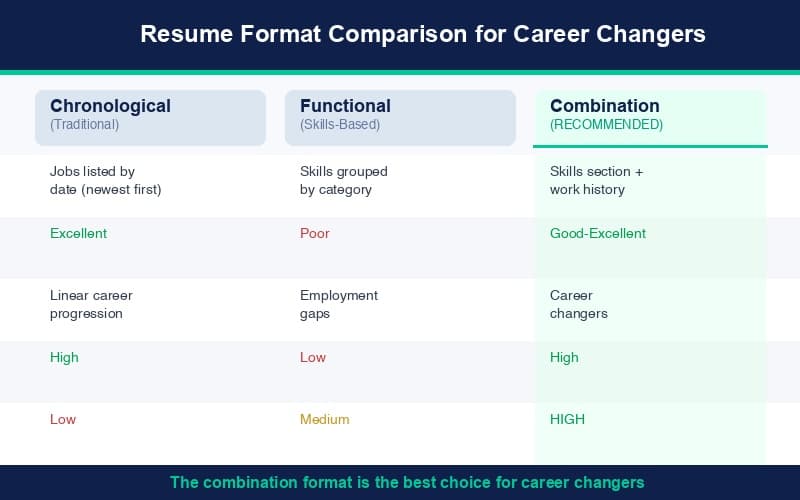
Not all resume formats work equally well for career changers. Here is how the three main formats stack up:
| Feature | Chronological | Functional | Combination (Recommended) |
|---|---|---|---|
| Structure | Jobs listed by date, newest first | Skills grouped by category, minimal job history | Skills section up top, followed by work history |
| Best for | Linear career progression | Large employment gaps | Career changers |
| Highlights | Job titles, promotions, tenure | Transferable skills | Both skills AND experience |
| Weaknesses for career changers | Spotlights irrelevant job titles | Raises red flags with recruiters; often rejected by ATS | Requires careful balancing |
| ATS compatibility | Excellent | Poor | Good to excellent |
| Recruiter perception | Familiar and trusted | Suspicious — "What are they hiding?" | Professional and strategic |
| Career change effectiveness | Low — old titles dominate | Medium — skills shine but context is missing | High — tells a complete transition story |
The verdict: Use the combination (hybrid) format. It lets you lead with a transferable skills section that immediately speaks your target industry's language, then follows with a work history that provides context and credibility. Recruiters get the skills match they are scanning for; the ATS gets the structured work history it needs to parse correctly.
Writing Each Section of Your Career Change Resume
The Professional Summary: Your 4-Sentence Elevator Pitch
Your resume summary is the single most important section on a career change resume. It is the only place where you can explicitly address the transition and control the narrative.
Here is the formula that works:
- Sentence 1: Your professional identity in the new field (not the old one)
- Sentence 2: Years of experience + transferable skills, framed for the target role
- Sentence 3: Your bridge experience (freelance, volunteer, certifications)
- Sentence 4: What you bring to the table / value proposition
Example (teacher transitioning to corporate training):
"Corporate Training Specialist with a foundation in instructional design and adult learning principles developed over 8 years in secondary education. Skilled in curriculum development, performance assessment, and facilitating learning for diverse audiences of 30+. Recently completed ATD Certified Professional in Talent Development (CPTD) and designed onboarding programs for two early-stage startups. Passionate about translating complex information into engaging, measurable training experiences that drive employee performance."
Notice what this does: it never says "former teacher." It positions the candidate as a training specialist who happens to have built those skills in education. That is the reframing career changers need.
The Skills Section: Speak Their Language
Pull keywords directly from job postings in your target field. If you completed the Phase 1 audit, you already know which of your skills translate. Now match them to the exact terminology employers use.
Do not write "good with people." Write "stakeholder management" or "client relationship development." Do not write "handled money." Write "budget oversight" or "P&L management."
A strong skills section for a career changer should include 8-12 skills, organized into 2-3 subcategories:
- Core competencies (directly relevant to target role)
- Technical skills (tools, platforms, certifications)
- Leadership & soft skills (transferable strengths)
The Experience Section: Reframe, Don't Fabricate
Here is where the combination format earns its keep. Your work history stays honest — same job titles, same companies, same dates. But your bullet points shift focus.
Before (generic):
"Managed daily restaurant operations including staff scheduling, inventory, and customer service"
After (reframed for project management):
"Directed cross-functional team of 25 across front-of-house and kitchen operations, coordinating scheduling, resource allocation, and quality control to maintain 4.7-star customer rating across 500+ monthly reviews"
Same job. Same responsibilities. Completely different story. The reframed version uses project management vocabulary — "cross-functional team," "resource allocation," "quality control" — while remaining 100% truthful.
Pro tip: Your Phase 2 bridge experience should appear prominently, even if it was unpaid. List freelance work under a "Relevant Experience" or "Selected Projects" section above your traditional work history. This ensures the most relevant content appears first.
The Resume Objective vs. Summary Decision
Some career changers wonder whether they should use a resume objective instead of a summary. Here is the short answer: use a summary. Objectives tell the employer what you want ("Seeking a position in marketing..."). Summaries tell them what you offer. In a career change, you need to sell your value, not announce your intentions. The employer already knows you want the job — you applied.
The one exception: if you are entering an extremely entry-level role and have minimal bridge experience, a brief objective paired with a robust skills section can work. But in 90% of cases, the summary wins.
Beating Imposter Syndrome on Paper
Let me be direct about something that no resume template can fix: the voice in your head that says you are not qualified.
I felt it when I submitted my first recruiting resume. I had a decade of restaurant management experience and three weeks of volunteer recruiting. Who was I to apply alongside people with recruiting degrees and five years at staffing agencies?
Here is what I learned: imposter syndrome lies about the math. It tells you that your old experience is worth zero and only your new-field experience counts. In reality, your years of professional experience have given you judgment, work ethic, communication skills, and domain knowledge that pure newcomers lack. A career changer with 10 years of professional experience and 3 months of bridge work is not the same as a fresh graduate. Not even close.
Practical antidotes:
- Quantify everything. Numbers bypass the "am I good enough?" question. You either increased revenue by 15% or you did not. You either managed a team of 12 or you did not. Numbers are facts, not opinions.
- Use your cover letter for the narrative. Your resume is a fact sheet. Your cover letter is where you explain the "why" behind the change — and a compelling "why" can be your strongest differentiator.
- Align your LinkedIn profile. Recruiters will check. If your LinkedIn still says "Proud Restaurant Manager" while your resume says "Project Management Professional," you have a credibility gap. Update your headline, summary, and featured section to match your resume's narrative before you start applying.
AI Tools That Give Career Changers an Edge
The resume-writing landscape has changed dramatically. AI tools can now help you identify transferable skills, rewrite bullet points in a target industry's language, and optimize for ATS keywords — tasks that used to require an expensive resume writer.
Use a professional resume builder that offers industry-specific templates and AI-powered suggestions. These tools can analyze job descriptions and recommend which of your existing skills to highlight, saving hours of manual keyword matching.
That said, AI is a tool, not a replacement for the work outlined in this guide. No AI can fabricate real freelance experience or earn a certification for you. Use it to polish and optimize after you have done the hard work of Phases 1-3.
Common Mistakes Career Changers Make (And How to Avoid Them)
1. Leading with what you are leaving, not where you are going. Your resume headline should not say "Former Teacher Seeking Marketing Role." It should say "Content Marketing Specialist | Curriculum Design & Audience Engagement." Always lead with the destination.
2. Including every job you have ever held. If you worked as a barista for six months in college and you are now a 35-year-old transitioning from finance to product management, the barista job adds nothing. Keep your resume focused on the last 10-15 years, and prioritize relevance over completeness.
3. Ignoring the ATS. Functional resumes might look clean to a human reader, but many ATS systems cannot parse them correctly. Stick with the combination format and include standard section headers: "Professional Summary," "Skills," "Experience," "Education," "Certifications."
4. Not tailoring for each application. A career change resume is not a one-and-done document. You should have a base version and customize it for each role, adjusting your skills section and bullet point emphasis to match the specific job description.
5. Skipping the bridge-building phase. This is the biggest mistake. Applying with nothing but transferable skills and enthusiasm is like showing up to a job interview and saying, "I have never done this, but I am a fast learner." Invest those 30 days in Phase 2, and you will have something concrete to show.
Your 90-Day Action Plan: A Quick Recap
| Timeline | Action | Resume Impact |
|---|---|---|
| Days 1-10 | Complete skills audit — list all transferable and translatable skills | Builds your Skills section foundation |
| Days 11-30 | Earn 1-2 micro-credentials in target field | Creates Certifications section; adds industry keywords |
| Days 31-45 | Land first freelance gig or volunteer project | Adds "Relevant Experience" section with real work |
| Days 46-60 | Complete 2-3 bridge projects; document all metrics and deliverables | Provides quantified bullet points and portfolio pieces |
| Days 61-75 | Write first draft using combination format | Full resume draft with all new content integrated |
| Days 76-85 | Get feedback from people in target industry; iterate | Ensures industry language and priorities are accurate |
| Days 86-90 | Finalize resume, align LinkedIn, prepare cover letter template | Application-ready package |
Final Thoughts
A career change resume is not about hiding your past or pretending to be someone you are not. It is about translating your past into the language of your future. The 90-day framework gives you time to build genuine evidence, earn relevant credentials, and write from a place of confidence rather than anxiety.
The workforce is changing. Skills-based hiring is expanding. The stigma around career changes is fading. The only question is whether your resume tells the right story — and now, you have a plan to make sure it does.
Start your skills audit today. Thirty days from now, you will be building bridge experience. Sixty days from now, you will be writing a resume that makes the career change feel inevitable rather than improbable. And ninety days from now, you will be applying with the kind of confidence that only comes from having done the work.
Ready to build your career change resume? Explore professional resume templates designed for career transitions, with built-in sections for skills, certifications, and bridge experience.