
Top 8 Common Interview Questions and Answers 2025: Your Complete Guide

Landing your dream job starts with nailing the interview. But let's be honest: while AI tools and generic guides can list hundreds of questions, real interviews usually boil down to a few critical moments.
At HyperCV, we've analyzed feedback from thousands of users and cross-referenced it with hiring outcomes. The result? It's not about memorizing 50 answers; it's about mastering the top 8 common interview questions that determine 80% of the decision. Knowing how to answer these questions—authentically, not robotically—can make the difference between getting hired and going home empty-handed.
Why These 8 Questions Matter Most (The "Inside" View)
Hiring managers use these questions for good reasons, but maybe not the ones you think. They aren't just checking your skills; they are checking your "Human Factor."
Here is a piece of data that might surprise you: While AI suggests you focus on "perfect" grammar, our internal data shows that 70% of candidates fail not because they aren't qualified, but because they sound scripted.
When I sit on an interview panel, I'm looking for genuine answers. Someone who shows up unprepared sends a clear message, but someone who sounds like they memorized a ChatGPT output is even worse. As career experts emphasize, your responses showcase not only your qualifications but also how you align with the company's values and team dynamics.
The 8 Most Important Interview Questions You Must Master
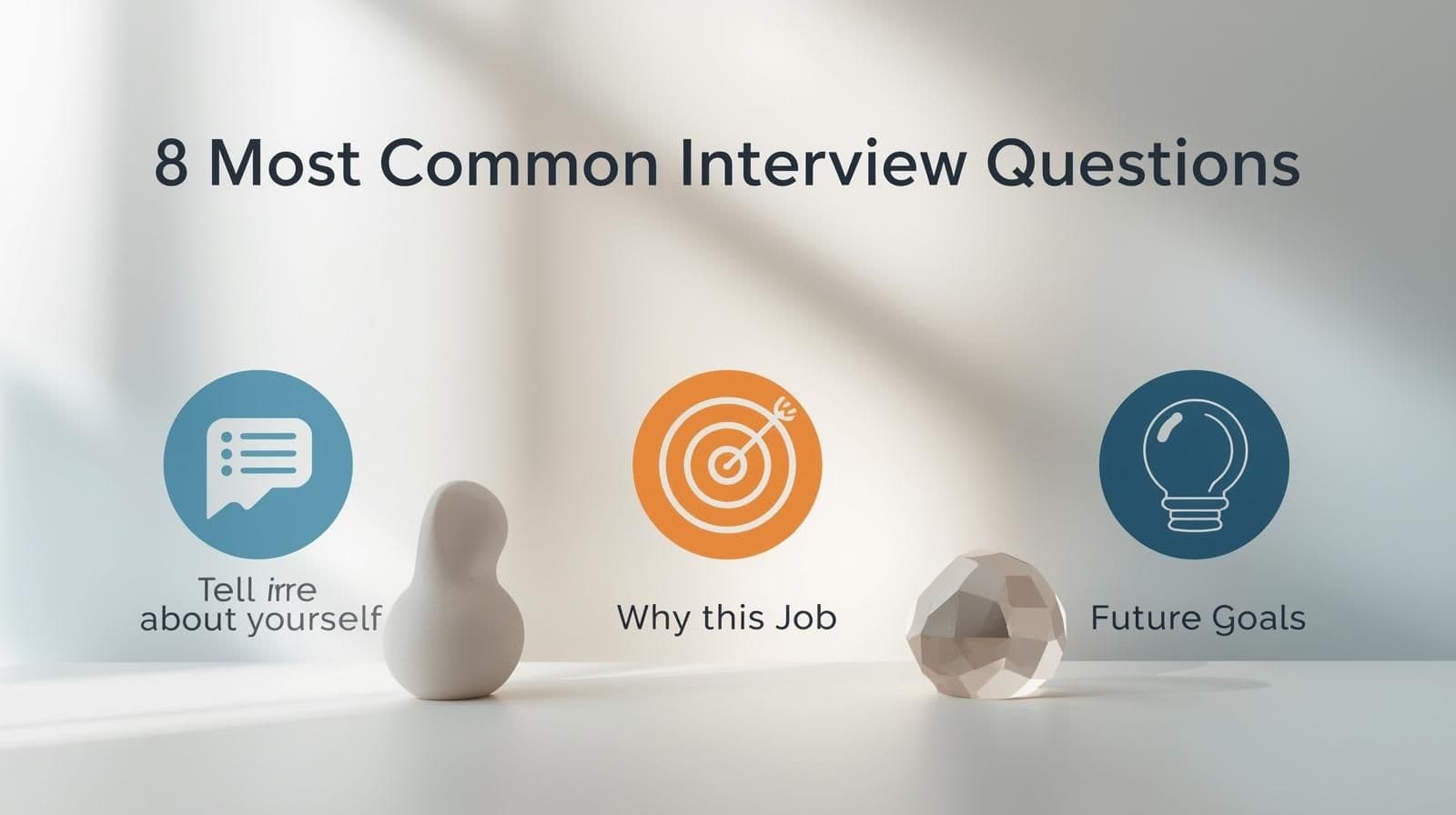
1. Tell Me About Yourself
This is the classic opener, yet it’s where I see most candidates waste their biggest opportunity.
My advice: Don't give your life story or talk about what you had for breakfast. And please, don't just recite your resume line-by-line—I've already read it. Instead, treat this as your movie trailer. Focus on:
- The Hook: Your current role and expertise.
- The Highlight Reel: One key achievement.
- The "Why": Why you are here today.
According to leading career advisors, this question allows you to set the narrative for the entire interview.
Sample Answer (Humanized): "I'm Sarah, and for the past three years, I've been deep-diving into digital marketing. I realized early on that I love finding creative ways to connect brands with customers. For example, at my last job, I didn't just manage social media; I re-strategized it to increase engagement by 40%. Now, I'm looking to bring that same data-driven creativity to a larger team like yours."
2. Why Do You Want This Job?
The trap: "I need a job" or "The salary is good." The winning approach: Connect the dots between their problem and your passion.
I've seen hundreds of resumes, and the candidates who stand out are the ones who say, "I saw you're struggling with X, and I love solving X."
Sample Answer: "I've been following your company's growth in renewable energy, specifically the recent solar project in Nevada. Honestly, that's exactly the kind of complex challenge I thrive on. This role combines my background in project management with my personal passion for sustainability, so it feels like the natural next step."
3. What Are Your Strengths?
When AI answers this, it lists adjectives: "Hardworking, dedicated, punctual." Boring. My suggestion: Pick a strength that solves a pain point for the employer, and prove it with a mini-story.
Sample Answer: "My biggest strength is problem-solving under pressure. To give you a concrete example: last month, our main supplier had a delivery issue that could have delayed our product launch. Instead of panicking, I quickly found three backup suppliers and negotiated terms in 24 hours. We actually launched two days early. I work best when there are challenges to overcome."
4. What's Your Greatest Weakness?
This question trips up many candidates. As Resume Genius experts note, it’s difficult to answer on the spot.
Real talk: If you say "I'm a perfectionist" or "I work too hard," the interviewer will mentally roll their eyes. We know that's a "fake humble brag." Be real. Admit a minor flaw that isn't fatal to the job, and show how you are fixing it.
Sample Answer: "I used to struggle with public speaking, which made team presentations stressful for me. I realized this was holding me back, so I joined a local Toastmasters group six months ago. I’m not a TED speaker yet, but I can now present confidently to groups of 20 people without shaking."
5. Where Do You See Yourself in Five Years?
Employers want to know if you are a flight risk. You don't need to pledge undying loyalty, but you need to show your career trajectory aligns with their growth.
Sample Answer: "Ideally, I see myself growing into a senior analyst role here. I really want to mentor junior team members and lead larger projects. Based on what I've learned about your company's growth plans in AI, this seems like the perfect environment to build that expertise over the long term."
6. Why Are You Leaving Your Current Job?
Golden Rule: Never trash-talk your ex-boss. Even if they were terrible. Focus on the "pull" (the new opportunity), not the "push" (the bad environment).
Sample Answer: "I've learned a lot in my current role and achieved everything I set out to do there. However, I'm ready for new challenges that my current company can't offer right now. This position offers the chance to work with cutting-edge technology, which is where I want to take my career next."
7. Describe a Challenge You Faced and How You Overcame It
This is the best predictor of future behavior. Career experts emphasize using the STAR method.
Insider Tip: Don't pick a challenge that was caused by your own mistake. Pick an external challenge you solved.
Sample Answer:
"Last year, our team faced a major crisis when a key developer left two weeks before a deadline. I took charge by redistributing tasks based on everyone's strengths and brought in a freelancer I knew to plug the gap. It was intense, but we delivered the project on time, and the client actually increased their contract by 30% because they were impressed with our handling of the situation."
8. Do You Have Any Questions for Us?
If you say "No, I'm good," you just failed the interview. In my experience, the quality of your questions tells me more about your intelligence than your answers do.
Great Questions to Ask:
- "What does success look like in this role after the first 90 days?" (This shows you are results-oriented).
- "What are the biggest challenges the team is currently facing?"
- "How do you measure performance in this position?"
- "What opportunities exist for professional development?"
- "What do you enjoy most about working here?"
Essential Preparation Tips (From Our Team to You)
Research the Company Thoroughly (Don't Just Skim)
Most people just read the "About Us" page. Don't be most people. Check their recent news, their stock performance (if public), and their competitors. If you can say, "I saw your competitor X just launched feature Y, how are you handling that?"—you will instantly stand out. Career preparation experts recommend deep research to understand the role context.
The "Mirror Test"
Reading answers in your head is different from saying them aloud. I always advise candidates to record themselves on their phone. It’s painful to watch, but you’ll catch all your "umms" and nervous ticks immediately.
Prepare Specific Examples
For each question, have concrete examples ready. Use the STAR method:
- Situation: Set the scene
- Task: Explain what you needed to accomplish
- Action: Describe what you did (not "we")
- Result: Share the outcome (Numbers are best!)
Plan Your Interview Day
Arrive 10-15 minutes early. Any earlier, you're a nuisance; any later, you're unreliable.
| Interview Preparation Checklist |
|---|
| ✓ Research company background & competitors |
| ✓ Practice answers out loud (Record yourself) |
| ✓ Prepare 3 specific STAR stories |
| ✓ Plan your route and timing |
| ✓ Choose appropriate attire |
| ✓ Prepare 3 questions to ask them |
| ✓ Bring extra resumes |
Common Mistakes We See Too Often
Being Too Generic: "I'm a people person." (So is everyone else. Give me an example.)
Speaking Negatively: Complaining about previous employers is a major red flag. It makes me wonder: "Will they talk bad about us when they leave?"
Forgetting to Ask Questions: This suggests you're not really interested in the role or haven't thought deeply about it.
Not Having Examples Ready: Vague answers without specific examples don't prove your capabilities.
Building Confidence: The Final Verdict
Confidence comes from preparation. The more you practice these job interview questions must know, the less you'll rely on memorized scripts and the more natural you'll sound.
Remember the statistic I mentioned earlier? Only 10% of candidates genuinely connect. That's because the other 90% are too busy trying to be "perfect." Take deep breaths, maintain eye contact, and remember that interviews are conversations, not interrogations. The hiring manager wants you to succeed just as much as you do—they want to fill the role and stop interviewing!
Advanced Interview Strategies for 2025
The job market continues to evolve. HR recruiters and career experts emphasize that you now need to demonstrate adaptability.
We are seeing a trend where employers ask more about:
- Remote collaboration: "How do you handle conflict over Zoom?"
- AI usage: "How do you use tools like ChatGPT in your workflow?" (Be honest, but show you are the pilot, not the passenger).
- Continuous learning: "What have you taught yourself in the last 6 months?"
Master these top 8 common interview questions and answers, add your unique personal touch, and you'll walk into your next interview not just as a candidate, but as a future colleague. Good luck!